
Introduction
The nature and quality of leadership thinking is the foundation of excellence. Figure 3.1 (below) shows it in the context of the wider principles.
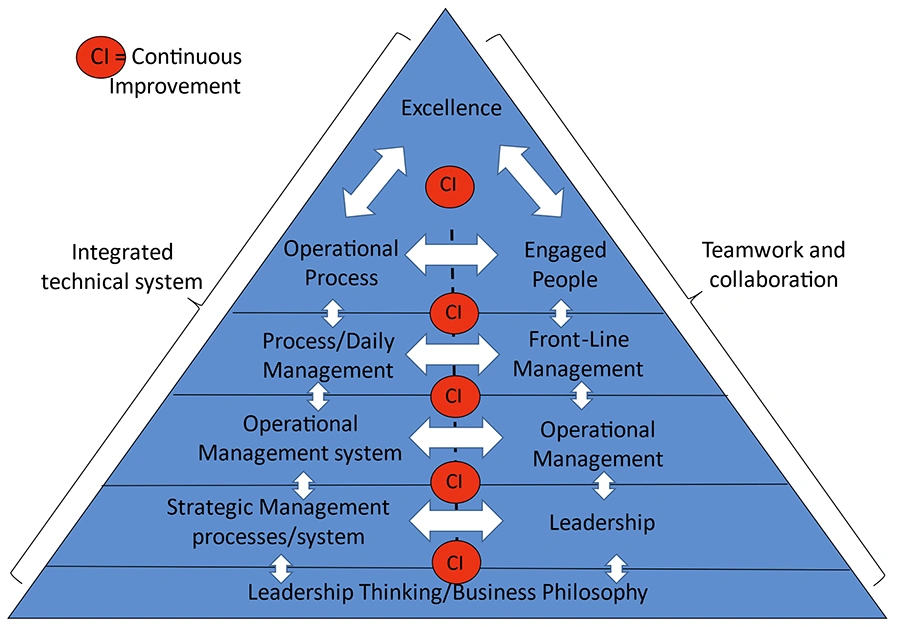
Figure 1: Simultaneous development of people, process and performance
Business Excellence is based on what Deming called ‘Profound Knowledge’, a philosophy comprising several core principles. Principles that differ significantly from earlier, less evolved approaches. Achieving Business Excellence requires an understanding of these leadership principles and commitment to them throughout the organisation, starting at the top.
The principles are summarised below. Some are subtle. They are all important. They all relate to each other and overlap to some degree.
- Meet the needs of all stakeholders
- Operational excellence provides competitive advantage
- Performance comes from the process
- Sustained profitability comes from loyal customers
- Quality comes first
- Manage flow
- The purpose of performance measurement is to inform and empower
- Continuous improvement optimises short-term performance and underpins long-term success
- Pursue perfection
- Plan-Do-Check-Act (PDCA) thinking drives performance management and continuous improvement
- Remove fear and engage people
- Develop a Thinking People System – simultaneously developing people, process and performance
- Respect for people
- Empower front-line performance
- Foster accountability and responsibility
- Facts and data, not emotion and opinion
- Systems thinking
- Proactively invest in value-enabling time
- Teamwork
- Excellence begins (or ends) in the boardroom
- Recognise problems as improvement opportunities
- Take a structured approach to problem-solving
- Develop kata – make excellence a habit
- Constancy of purpose and long-term thinking
Let’s explore them in more detail.
Meet the needs of all stakeholders
The assumption in Business Excellence is that sustainable success depends on satisfying the legitimate needs of all key stakeholders. That is, focusing on the quintuple bottom line – being first choice to buy from, work for and invest in while making a positive social and environmental impact– wins loyal customers, creates an engaged, high-performing team, attracts committed financial backers and secures a reputation as a socially and environmentally responsible business. All of which creates a strong platform for sustained success.
Operational excellence provides competitive advantage
Sustained profitable growth is what the strategic planners of the world are always seeking, but find hard to achieve because their company’s operations cannot deliver on their strategy.
(James Womack and Daniel Jones)
Operational excellence is:
- The ability to deliver what the customer wants right first time, on time, every time, to cost
- The resilience to do this consistently in the face of various challenges
- The ability to improve and adapt seamlessly to external change
In competitive environments where delivering on a promise is make or break, operational excellence is the key to both retaining and improving competitive advantage.
Performance comes from the process
Results are not mysterious happenings. Consistently excellent results can only come from excellent processes run by people who are well trained and engaged.
In Business Excellence, the primary focus is on continuously enhancing the ‘means’ (process and people) to improve the ‘ends’ (the results). Optimising process capability and performance by engaging and involving people in process design, management and continuous improvement.
The alternative is to focus on achieving an end goal without regard for the impact on the process. For example, pushing through more volume than it can handle, or constantly changing priorities to avert one crisis, only to create the next one, thus constantly sub-optimising both process and results.
Managers may also try to drive performance by ‘tough’ management – pushing people harder. This may provide an artificial short-term boost, but over time, no amount of pushing from managers, or positive attitude or effort from colleagues, can overcome the limitations of a process that is poorly designed, equipped and managed. It invariably results in demoralisation, adds to the sense of chaos and leadership incompetence, and may even lower productivity as people disengage and push back.
Sustained profitability comes from loyal customers
A fundamental assumption in Business Excellence is that strong and sustainable profitability is generated by loyal customers: customers who willingly return, are low-maintenance and who recommend the business to others. They are more valuable than a customer who is merely satisfied, will still shop around and may haggle over price. Loyal customers mean lower costs and higher sales because they:
- Require lower sales and marketing costs, as they require less persuasion and there is lower customer churn
- Tend not to rely on discounting
- Are more open to upselling and cross-selling
- Are more forgiving of the occasional hiccup, so there is less handling time, cost and distraction
- May add value by being unpaid advocates for the business, and also by working in partnership to help improve the offering
Quality comes first
There are two aspects to quality. The first is understanding what matters to the customer and designing a product or service that meets their needs. This need not necessarily be something technologically advanced or with all sorts of bells and whistles (indeed, pointless complexity can be a turn-off for some). It simply needs to do what the customer wants it to do, be available when they need it, and at a cost they feel offers value.
The second is developing an efficient process that delivers the product or service right first time, on time, every time. Getting things right first time means fewer defects. This minimises costs, maximises productivity, facilitates on-time delivery, and enhances customer satisfaction and profitability.
Phil Crosby debunked the myth that higher process quality means increased cost. He pointed out that getting quality right first time costs less than getting it wrong, since fixing any problems that we create absorbs time and money and incurs an irrecoverable loss of production capacity, lowering overall volumes and productivity.
His model (Figure 3.2, below) suggests that the activities required to prevent problems, i.e. to set up and run the process properly, take around 15% of operating costs. If, instead, problems are allowed to occur, the costs of inspection and fixing quality fails detected either externally or internally amount to around 40% of operating costs. On top of this there is what Deming called the ‘unknown and unknowable’ costs associated with creating unhappy customers who complain, want discounts, leave and discourage others from buying from us.
The upshot is that process quality must come first or we open the door to all manner of problems with productivity, reliability, customer satisfaction, cost and profitability. Investing time in getting the offering right and in getting the process right creates loyal customers and increases value-adding capacity. The very essence of working smarter, not harder.
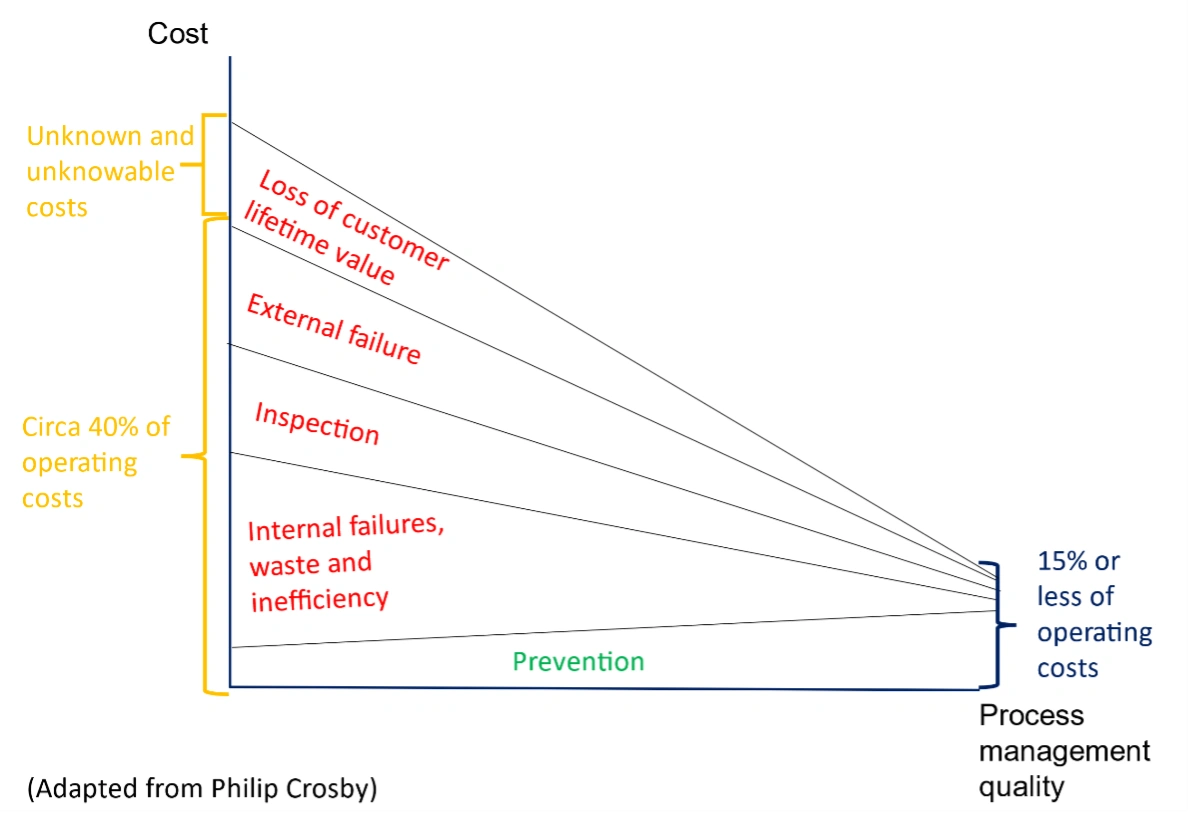
Figure 3.2: The cost of quality
Manage flow
Flow is a crucial concept in Business Excellence: work must move through the value-adding process, without error or any unnecessary delay, movement, handling or processing. Anything else is waste – it costs time, money or other resources but adds no value.
Managing how work flows highlights the waste and allows it to be removed. This increases profitability and frees up capacity that could be used to grow the business, because:
a) Profit = selling price, minus the cost to make, minus the cost of the waste
b) Value-adding capacity = process capacity minus the capacity subverted by waste (defects and inefficiencies)
Flow should be managed end-to-end across the whole value stream, to ensure that the system is optimised as a whole.
The purpose of performance measurement is to inform and empower
Measurement, when used well, is a powerful tool for managing and improving performance. In Business Excellence, measurement has a clear purpose: to empower and enable people to manage and improve performance.
To facilitate this technically, performance information that is visible, understandable and actionable should be available to all colleagues in real time. Socially, this requires an environment where information is used to understand and improve performance; where colleagues can discuss problems, offer ideas and innovate in an environment free of blame and fear.
The combination of ongoing challenges, readily available performance information and fast problem-solving is what makes sport intrinsically motivating. With the intelligent use of performance measurement, any business can tap into this.
Continuous improvement optimises short-term performance and underpins long-term success
Sustainable success requires the capability for fast and effective problem-solving to respond successfully to daily challenges, to make ongoing improvements to process performance and to adapt to wider changes as markets, technology etc. evolve.
Culturally embedding a mindset of continuous improvement is vital because:
- A static system is a vulnerable system:
- Entropy is always invisibly degrading processes. So the speed at which we counteract this must be faster than the rate of decay
- The business has to respond to changing external conditions, so its rate of internal adaptation must be faster than the rate of external change
- Robust cost and quality competitiveness tends to result from the compounded accumulation of small improvements over time
- Without it, problems accumulate and are only addressed when crisis point is reached, and in a very reactive way. Improvement stops when the immediate crisis has passed and so the cycle repeats. In line with the principle of ‘Pursue perfection’ (see below), process improvement should be ongoing and not just stop when a set performance goal is reached.
Pursue perfection
Perfection is defined as the complete elimination of wasted time, effort and resource so that the customer can be served exactly what they need, only what they need, and exactly when they need it, with no delay and at minimum cost. It is understood that this is not completely achievable, but that the pursuit of perfection is necessary to deliver the best of what is possible – excellence and continuous improvement. Anything less opens the door to complacency, the acceptance of mediocrity and the risk of losing competitive advantage to hungrier and more ambitious rivals.
Plan-Do-Check-Act (PDCA) thinking drives performance management and continuous improvement
PDCA thinking (see Figure 3.3, below) is the disciplined and systematic approach that underpins the management of performance and continuous improvement at any level; strategic, operational-management or operational. It brings a structure to people’s thinking and creates a constant iterative and incremental approach to management and improvement. It is the engine that drives Business Excellence.
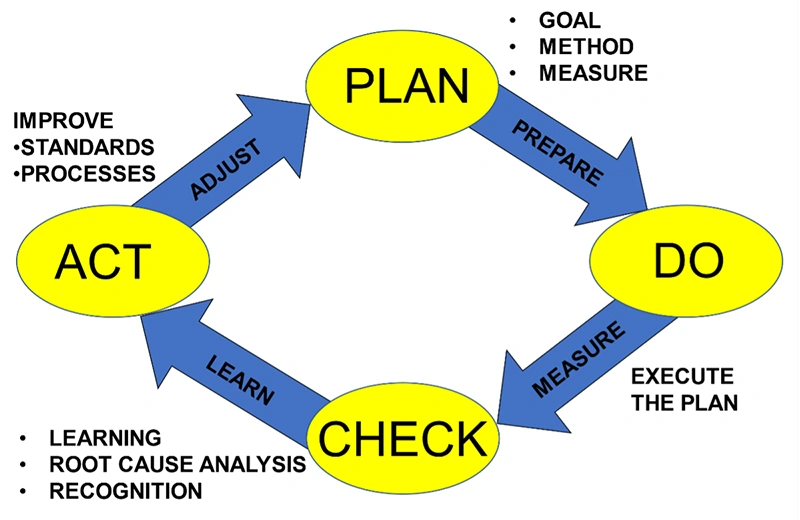
Figure 3.3: The Plan-Do-Check-Act cycle
From a technical perspective, it is a constant loop of:
- Planning: Defining a goal, the method for achieving it and the measure by which success will be assessed
- Doing: Executing the plan
- Checking that the plan was followed and that the outcomes were as expected, and if not, ascertaining why not
- Acting on the lessons learned during Check, and adjusting the method, goal or measure to reflect what has been learned
From a social perspective, how ‘Check’ is run significantly influences the organisation’s culture. If it is characterised by blame, the fear of it will likely cause people to shut down and disengage. Trust will diminish, and it may become contentious. Little progress will be made. A more productive approach is, first, to see problems as opportunities for process improvement and, second, to remove fear and engage people.
Remove fear and engage people
Deming memorably noted that in his experience, around 94% of problems and possibilities for improvement related to some aspect of the operational or management processes, with only 6% due to other factors, which may include bad weather and bad luck as well as individual errors. The best approach to understanding and addressing problems is therefore to view people as the solution, not the problem, and begin by asking ‘How did the process let this happen?’, rather than ‘Whose fault was that?’ This avoids fear and blame and engages people positively in the quest to solve the problem; it directs focus to the likeliest root cause and avoids the risk of alienating people, creating defensiveness and deflecting the focus from the source of the problem.
This is part of the wider aim to…
Develop a Thinking People System – simultaneously developing people, process and performance
The aim is to develop the culture to become a ‘Thinking People System’ (or ‘Learning Organisation’), where people are actively and positively engaged in managing performance, solving problems and improving processes.
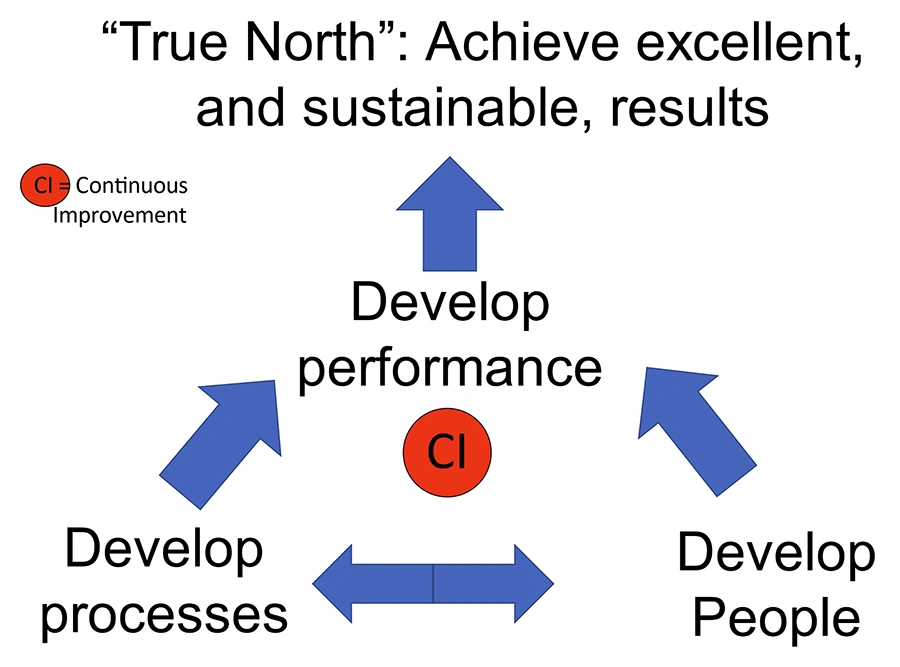
Figure 3.4: Colleague engagement/Thinking People System
The co-development of people, process and performance drives an upward spiral:
- As people are engaged, they take more responsibility for performance and results. This helps them understand what is happening in the process and how it can be improved
- This develops people’s business understanding, process-knowledge, and problem-solving and teamworking skills
- As people learn and improve the processes, performance improves, creating an upward spiral.
This creates a culture that is able to learn, adapt and respond quickly and intelligently to challenges: a Thinking People System.
What follows from this is the principle that management and improvement is best done by front-line teams; the people who understand the processes best because they use them every day. They should have the capability to change the systems rather than be constrained by their limitations.
This is based on another of the key tenets of Business Excellence…
Respect for people
Respect for people includes treating them with dignity and courtesy, of course, but also involves:
- Recognising that the people who do the job are the experts in that job, and, if properly led, engaged, empowered and developed, will make a significant positive difference, through problem-solving and continuous improvement, to quality, customer service and process performance
- Treating people like capable and responsible human beings and providing a positive challenge to improve, learn, develop and pursue ambitious goals, and in the process stretch themselves, unlock more of their potential, and achieve more.
Empower front-line performance
Since it is the people at the front line who directly provide the product or service to the customer and manage the front-line processes, operational excellence depends on them being properly enabled and empowered to do this.
The role of managers at successive levels of the organisation, therefore, is as illustrated in Figure 3.5 (below); to make sure that people have the right information, equipment, raw materials, training and support, when they need it.
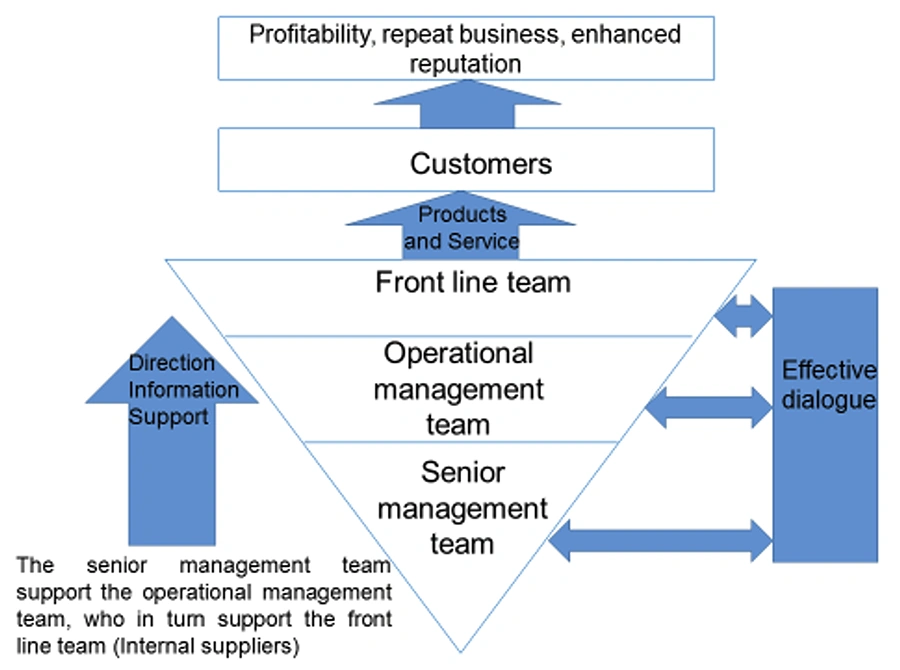
Figure 3.5: Enabling front-line colleagues
To make this work it is therefore necessary to…
Foster accountability and responsibility
Accountability means being answerable for decisions, actions and outcomes. Responsibility is having the ability, resources and autonomy to perform to the expected standard, make decisions and take action. People should be both accountable and responsible for the results they are paid to deliver. Starting at the top.
To facilitate this, the management system should be designed to do two things:
- Provide a tiered approach, to get the right accountabilities and responsibilities at the appropriate levels. Front-line teams should have accountability and responsibility for the operation and performance of front-line processes. Managers at successively higher levels should be accountable and responsible for progressively larger portions of the overall system performance
- Strike the right balance between accountability and responsibility at each level so that people are able to adequately influence the results they are accountable for
Facts and data, not emotion and opinion
The focus in managing and improving the process should be primarily on the facts and data gathered from the measurement of process performance, rather than on emotion and opinion. This is crucial in creating a culture where people engage in finding and removing the actual root causes and driving meaningful process improvement. When subjective opinion and emotion dominate, the quality of the dialogue suffers and can become a battle of egos and personalities, damaging teamwork and preventing people from developing a full and accurate understanding of the system.
Gut instinct, hunches, organisation folklore, pet theories and previous experience all, arguably, have their place in understanding and improving process – but there is a serious danger when they are used in the absence of sound facts and data about how a process is actually performing in reality, and whether our actions to improve the process are working in practice.
Systems thinking
Systems thinking means recognising that a business is a complete, interconnected socio-technical system and being able to discern its constituent parts, figure out the internal relations and dynamics and what the highest leverage variables are, so as to be able to intervene intelligently.
And it means doing this through positive engagement with others, since other actors not only affect the different aspects of the system, but are also a crucial aspect of the system.
Part of this is recognising that to improve any aspect of performance (quality, delivery performance or cost), every part of the organisation needs to be aware of, and accountable for, the impact it has on that metric, and be open to improvement.
There are two dimensions to this. The first is horizontal, optimising the performance of the entire value chain as it runs end-to-end through various front-line functions. The second is vertical, recognising that the operational processes will only be as effective as the management system they are embedded within. This highlights the importance of a properly designed and managed strategic management system, operational management system and process management. They need to be sound in themselves and integrated, aligned and coordinated vertically.
Proactively invest in value-enabling time
Broadly, there are three ways time can be spent in a business:
- Value-adding: Activities that directly contribute to creating the product or service that the customer wants and will pay for
- Value-enabling: The planning, organising, communicating, managing and developing, coaching, reviewing of performance, and process-improvement required to optimise the efficiency and impact of value-adding time
- Waste: Time spent on anything else; correcting defects or errors, waiting for information, raw material or equipment, doing things that the customer didn’t ask for, doesn’t want, and won’t pay for, etc
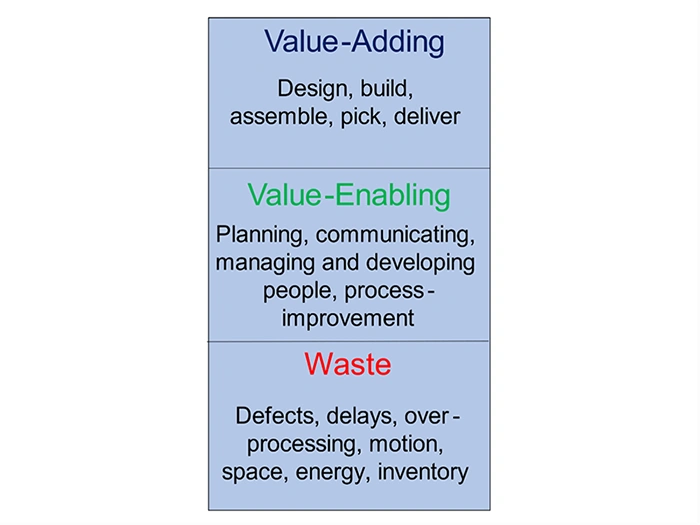
Figure 3.6: Three ways that time is spent in business
There is an interactive relationship between the three. Enough value-enabling time needs to be invested regularly, and spent wisely and efficiently, to create an upward spiral. Otherwise, waste increases and value-adding time, efficiency and cost suffer, potentially creating a downward spiral.
As Figure 3.7 (below) illustrates, it is easy to get trapped in a loop of firefighting and stagnation.
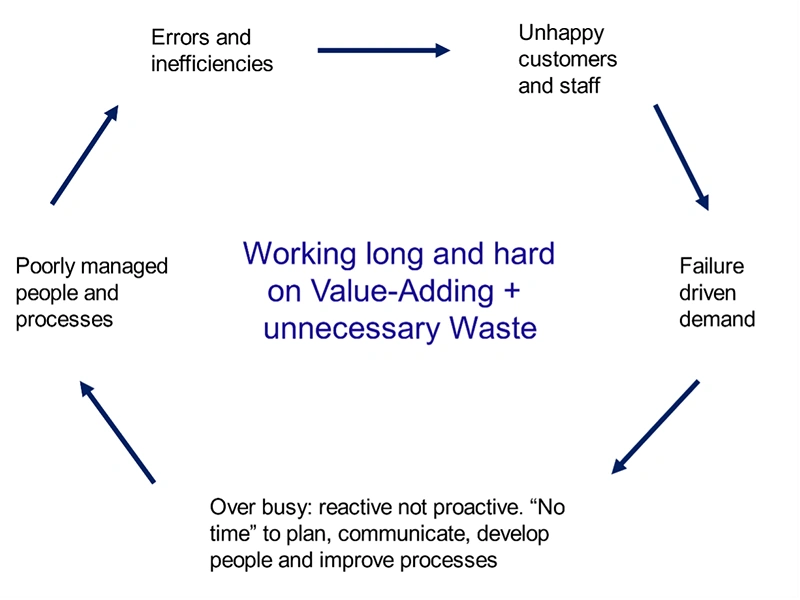
Figure 3.7: The mediocrity loop – working hard to stand still
But as Figure 3.8 (below) shows, investing value-enabling time and learning to do it efficiently, well and with discipline can create an upward spiral of sustainable and continually improving performance.
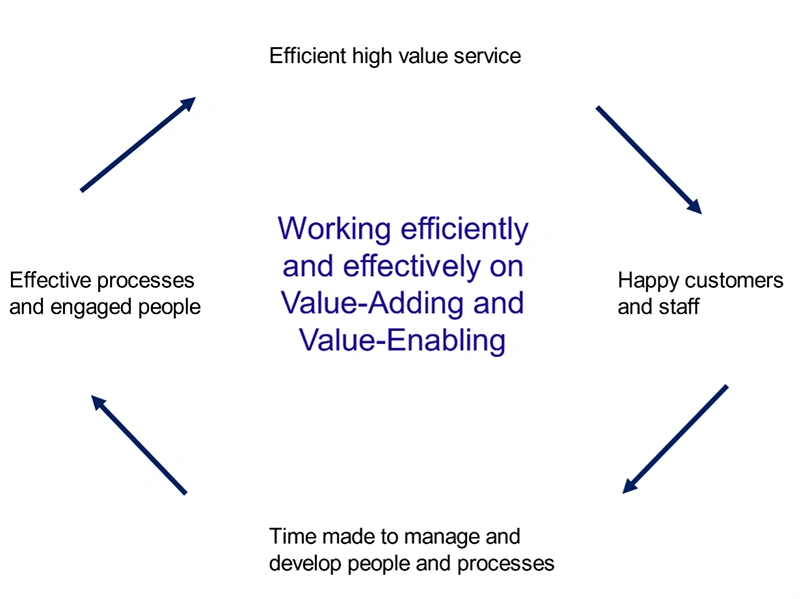
Figure 3.8: The leadership loop: value-enabling time drives performance and improvement
Teamwork
Since every business is a system, its efficient working requires effective coordination which relies on cooperation and collaboration across different functions and between different hierarchical levels. Fostering teamwork has both a technical aspect and a social aspect.
The technical enablers of team performance are:
- Goals that:
- Make overall performance pre-eminent. The optimisation of the overall end-to-end process should be made the primary focus for every team, with the optimisation of local processes that comprise this. This mitigates against the risk of destructive internal competition and the risk of a (supposed) improvement in one area (e.g. cost savings) having a significant unintended negative impact on the process overall (e.g. quality problems)
- Align functional goals. The output goals of each process stage must be aligned with the needs of the adjacent stage to create smooth flow horizontally and vertically at hand-offs and along the entire process, coordinating the timing, volume and quality of the flow of material and information
- An effective operational management system to oversee and coordinate the whole system, monitoring performance and identifying and resolving problems. As part of this, appropriate forums should be designed to facilitate cross-functional communication, collaboration and problem-solving
Socially, achieving teamwork requires the right leadership, to develop collaboration as a cultural instinct and habit. As well as putting the aspiration for excellence and shared success front and centre, this will also include defining, living and embedding values that encourage collaboration and cooperation and discourage individualistic and destructive internal competition.
Excellence begins (or ends) in the boardroom
Leadership is the most important single determinant of success in Business Excellence. There is an attitudinal and behavioural aspect, and also the direct practical impact of how well leaders serve people by providing what they need to succeed. Let’s look first at the attitudinal and behavioural aspect of leadership.
People look for positive and competent leadership: leaders who provide a clear positive vision to work toward, who lead by example, role-modelling the values, attitudes and behaviours of Business Excellence, and who have earned people’s trust and respect.
At a practical level, leadership competence is measured by the degree to which people are are enabled, involved and empowered. Key factors in enabling, supporting and promoting engagement are:
- Positive leadership: Senior colleagues, starting at the top, leading by example, role-modelling the values, attitudes and behaviours that actively promote and support the principles and practices of Business Excellence
- Meeting hygiene factors: Basic expectations which, if not met, will create a black hole of dissatisfaction and distrust that cannot be compensated for by any ‘motivator’
- Clear expectations: Of goals, standards and methods
- Tools, equipment and resources: Of the right quality, available at the right time
- Capable processes: Well-designed, reliable processes, working within capacity
- Skills and knowledge: Adequate quality and breadth of training
- Information on performance: Timely, frequent, actionable facts and data
- Appropriate autonomy and responsibility: The right degree of empowerment, authority, and responsibility to improve performance
- Accountability: People must be answerable for decisions, actions, performance and results. Regular opportunities to discuss performance, problems and ideas are provided: scheduled, constructive forums, free from fear
- Effective coaching: As part of everyday work to develop rounded, confident, responsible people with strong job skills, problem-solving skills and interpersonal and team-working skills
- Structured problem-solving skills and tools: The availability of a shared language and toolkit for structured problem-solving, with all colleagues trained to at least a basic level to enable them to contribute meaningfully to improvement activities
- Involvement in problem-solving activities: To contribute insights and ideas to improve process and performance, and to simultaneously further develop their understanding of the process, and their problem-solving skills
Since the bulk of the causes of low quality and low productivity belong to the management system and thus lie beyond the power of the workforce, leaders need to take responsibility for the design, management and improvement of the management systems that provide the above.
Recognise problems as improvement opportunities
In Business Excellence, problems are viewed as opportunities to learn more and more about how the process works and how to improve it, and to simultaneously develop people’s problem-solving and teamworking skills.
The mentality is therefore to actively bring problems to the surface and solve them, rather than ignoring or covering them up and continuing to suffer the financial and operational consequences.
Take a structured approach to problem-solving
Taking a structured approach to problem-solving is vital. Without it, we can make all sorts of costly errors and not notice. We can fail to properly define the problem and go off at a tangent. We can miss the actual root cause and have the problem recur. We can take the wrong actions. And we can fail to follow through the PDCA loop and never really establish if the solutions we thought would work actually did.
One popular approach is A3 problem-solving (named after the size of the sheet of paper it was originally captured on). It walks our thinking through a series of logical steps that first identify the root cause, then develop potential solutions, test them and adopt those that are proven to work. These steps are:
- Theme/background: Define the broad area of focus, e.g. quality
- Problem definition: Tightly specify and measure the problem to accurately define it and the impact it has
- Goal/target state: Specify where we want to be at the end of this exercise
- Root cause analysis: Using various techniques, isolate the most probable root cause
- Containment measures: Implement any short-term actions require to prevent major problems while a permanent solution is found and applied
- Proposed countermeasure(s): What actions do we think will reduce or eradicate the problem?
- Action plan: Specify who will do what by when
- Impact check: A check-in to see if the action plan was followed and what the results were
- Next actions: If the countermeasures worked and the situation is where it needs to be, we close out the A3. If the countermeasures did not fully succeed, we go back to the beginning and double-check our thinking at each stage
Develop kata – make excellence a habit
An organisation can navigate challenging situations more effectively if it has deeply embedded habits and routines (‘kata’) for managing and improving processes. These disciplines should be the backbone of the management system. They also rely on leaders and managers, starting at the top, ensuring that they are run when they should be and to the right professional standard.
Constancy of purpose and long-term thinking
Excellence is not a programme with a beginning and an end, but a philosophy that directs efforts at all levels of responsibility towards the more effective use of the resources available, to meet the needs of the customers.
(Jeffrey Liker and James Franz)
Business Excellence requires a long-term approach, balancing the need for short-term results with the steady, disciplined building of the capability for higher levels of sustainable success.
It is not a ‘programme’ that is ever done. It is a philosophy and a set of practices that need to be persisted with and constantly evolved over time.
Questions
Thinking about both
- You as a leader
- Your leadership team
Where are the:
- Existing strengths?
- Waterline issues? (as in ‘sunk below the’ and presenting danger)
- Breakthrough opportunities?
