
Excellence and the alternatives
Every business culture, like every human personality is unique, but it is possible to identify some broad categories and to gain some insight into how they are created and sustained, and into the results they produce. This can help us to understand the culture of our own business, create a vision of where we want to be, and to take steps to get there.
Figure 1 below shows four broad types of culture and the two key dimensions on which they differ (focus on performance and degree of engagement):
- The Excellence culture is our main focus here, as it offers the best prospects for sustainable high performance and benefits for all stakeholders in the context of 21st century conditions, opportunities and threats.
- Command and Control cultures are based on the “traditional” philosophy of the early 20th Century. Obsolete in many industries, still prevalent in others.
- Chaotic cultures lack focus, organisation and are minimally concerned with how people experience the business
- Cosy cultures tend to enjoy guaranteed business and lack focus, rigour and discipline in their approach to business management and improvement.
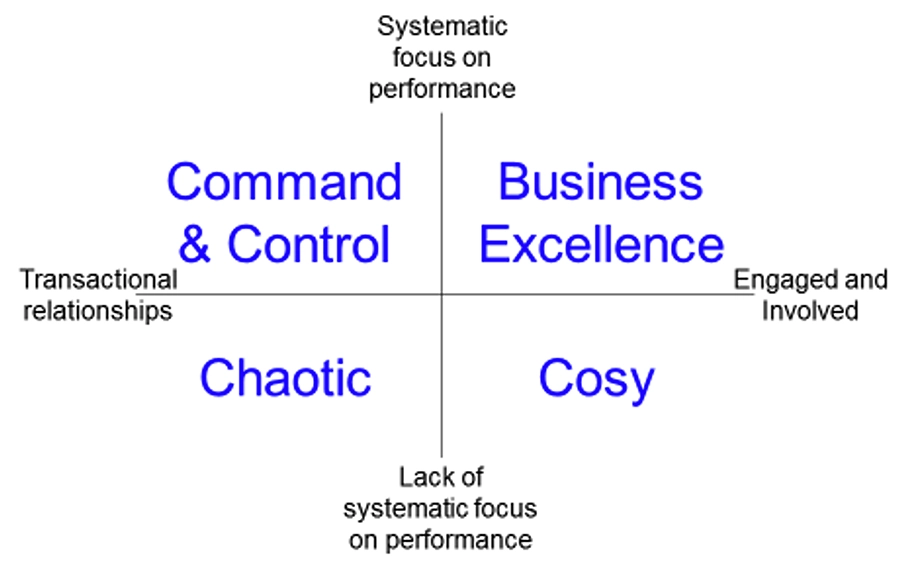
Figure 1 – Culture Alternatives
Let’s explore this in more detail
Business Excellence
In an Excellence culture, there is a relentless commitment to quality, continuous improvement, and colleague engagement. This is communicated and supported from the top.
Figure 2 illustrates the dynamics.
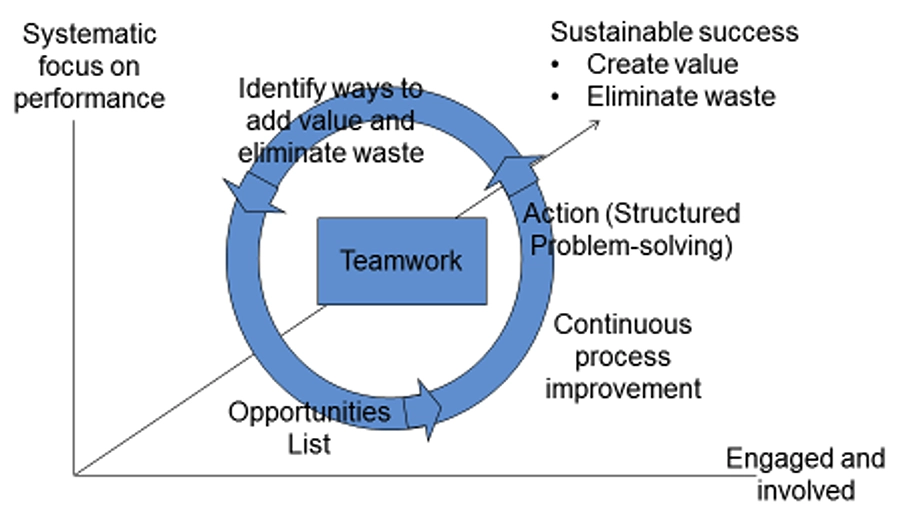
Figure 2 – Excellence Culture Overview
The ultimate aim is sustainable success, achieved by a focus on creating more of what customers value, and eliminating the waste in processes. Performance is managed systematically at all levels with a strong focus on process effectiveness: Constantly and actively looking for ways to enhance quality and productivity by identifying and removing the causes of errors, waste, and inefficiency. Relevant measures and reliable data are used to inform discussions about performance, and to identify improvement opportunities. Appropriate time is made available for process-improvement. Improvement projects are implemented effectively and seen through to completion.
Colleagues are actively and constructively engaged and involved. Managers understand that their role is to enable people to bring their full experience, knowledge and problem-solving abilities to the quest to deliver excellence and continually-improving performance. This means ensuring that people are:
- Equipped with the right, information, tools, skills and processes to allow them to succeed
- Actively and positively supported to perform:
- Held accountable through regular constructive discussion of performance and improvement
- Coached effectively as part of everyday work
- Listened to: Concerns and problems that are preventing them from succeeding are understood and addressed
- Trained in process-improvement concepts, tools and techniques
- Actively involved in continuous improvement activities
- Able to communicate openly and honestly about performance and analyse, discuss and solve problems, free from fear and blame
The simultaneous focus on performance and engagement creates an ongoing cycle of identifying ways to remove waste and add more value and using structured problem solving to create effective and sustainable solutions. This all revolves around teamwork, both within teams and between different teams (vertically and horizontally) across the business to ensure that the whole system is improved end-to-end in a coherent way.
All of this creates the potential for an upward spiral of sustained, and continuously improving high-performance, and the agility to adapt to changing markets: A strong foundation for sustained competitive advantage.
This makes the business more attractive to buy from, work for, and invest in because:
- The quality, reliability and competitive pricing that operational excellence brings helps to retain existing customers and attract new ones and thus create a stable and loyal customer base
- With strong levels of colleague engagement, the organisation is better able to attract and retain top talent, and get the best from them
- Having a solid and growing customer base, a stable and engaged team, strong profitability, and being well positioned for growth, Excellent organisations are also more attractive to invest in
Alternatives to a Culture of Excellence and their dangers
Cosy cultures exist where work is either guaranteed or has historically just rolled in consistently. The customers are either happy, undemanding, or have little power to change poor levels of service. People can pretty much work away in their own way at their own pace. There is a belief that things will always go this way. This creates a measure of comfort, which can turn into overconfidence, complacency (and sometimes arrogance).
Everything hinges upon luck and good feelings, upon the personalities of the people and the good will they share. Unfortunately, personalities, good feelings, good will and luck aren’t the ingredients of successful organization, but the recipe instead for chaos and disaster. (Michael Gerber)
This type of culture ticks along until some change in market dynamics, ambition, or economic conditions brings pressure to deliver more, better, faster, or cheaper. This can push the culture out of its comfort zone. Lacking the ability to adapt quickly, it is in danger of tipping toward chaos.
Cosy cultures can include smaller or younger entrepreneurial organisations with lots of positive energy who have not yet reached the point of needing to formalise and structure the business. Postponing that moment too long brings serious danger as things can too easily slip into Chaotic territory.
Long-established organisations can also reside in this category. Their challenge is more likely to be complacency, apathy and an “it’s always been fine, and my job is secure so why change” mentality, and sometimes an attitude of indifference toward customers. They too are in danger of being driven into chaotic territory if customer demands, financial or other pressures increase and their management system and culture are not sufficiently developed or mature enough to cope.
Even when ticking along nicely though, the performance of a Cosy culture is usually mediocre (compared to their potential) because there is no sustained and disciplined focus on results and underperformance is not constructively challenged or addressed. This kind of culture can be okay to work for but lacks positive challenge, and is frustrating for colleagues when problems are raised but go unaddressed. It’s an underwhelming experience for customers and not hugely attractive to invest in.
In a Chaotic culture there is inconsistency, disorganisation a sense of chaos and regular conflict.
Here, there is no systematic focus on performance, though when things go wrong people may discuss problems passionately – but leaning more on emotion and opinion than facts and data, and seeking to defend themselves and blame each other rather than trying to understand problems and identify and resolve root causes.
Communication and people-management are unsystematic and inconsistent. There is no structured or disciplined approach to continuous improvement. People react to circumstances, making snap decisions with little apparent logic or connection to an underlying strategy or plan, and often without consultation or real consideration of the longer-term and wider consequences. Managers see themselves as fire-fighters, there to resolve a constant stream of problems to ‘get stuff out the door’ and achieve short-term goals.
As a result, frequent mistakes are made and most are made time and time again. Little is learned or improved. Quality is poor. People feel that they are not trusted, respected, informed, listened to, consulted, involved or properly thanked or rewarded. As a result they are usually somewhat unhappy, stressed and disengaged either through indifference or for self-protection.
Absenteeism is often high, and the business struggles to attract and retain talent. It is a constant struggle to retain customers, maintain repeat business and up-sell. Financial performance is often inconsistent and well below what the business is capable of. This makes it harder to attract long-term investment. All this creates a negative spiral of stagnation, frustration and underachievement.
Despite this, businesses in this space can survive and operate profitably if they:
- Have a highly specialist niche offering
- Operate in markets where customers and employees have nowhere else to go
- Operate in markets where customers will accept poor quality and service for a budget price
- Operate in markets where the competition is no better, or worse.
In Command and Control cultures there is a strong emphasis on performance-management, control and discipline, but little on engagement or empowerment. Where this is coupled with an overriding focus on short-term financial results, the measures and reward systems are geared more toward current financial performance than to building long-term capacity and customer loyalty or employee commitment. Relationships (with customers, employees and suppliers) tend to transactional, sometimes exploitative and usually strained. Little loyalty or goodwill is either shown or expected in any relationship.
With this transactional mindset, engaging employees is not seen as important. People are viewed, essentially, as a cog in the machine. Strong cost-control may mean that pay is kept as low as the market (or the law) will allow. People are and hired and fired in line with short-term needs. Change is driven top-down. Done to people rather than with them.
Colleague commitment and motivation is usually low and people tend to withhold the discretionary aspects of their potential contribution, and are reluctant to take initiative, contribute ideas and to go the “extra mile”. Most just turn up and deliver the basics. Some give up, switch off and do the bare minimum. Others develop a negative attitude toward their work, the organisation, and the management. In these cultures, people are, consequently, difficult to manage and motivate.
Absenteeism is high, and good people are hard to attract and retain. Management often respond to all of the above by taking a hard line. This just deepens the us-and-them attitudes all round, creating a spiral of mutual mistrust which makes it harder to communicate, motivate and solve problems, all of which filters through and impacts on quality, productivity, delivery performance and customer service.
The customer experience can range from good (for standard, low-complexity products and services), to disastrous, where products and services are mis-sold, over-priced, of poor quality or arrive late. Attempts to complain are met with impenetrable phone or online systems, bureaucracy, inefficiency, lack of genuine concern and sense of game-playing.
Some Command and Control organisations work hard at presenting an image of being customer friendly, environmentally responsible and good employers, but this is often window dressing in the name of brand image rather than indicating a genuine commitment.
Command and Control cultures are typically found in industries whose business model is built around high-volume low-margin products or services which can be provided by an unskilled or semi-skilled workforce, but can also be found in high-skill environments like financial services. They are usually large companies in markets dominated by a small number of large players, for example utilities, telecoms and banking.
If well-run, their financial returns can be steady, making some Command and Control cultures attractive to invest in. Few, if any, however are truly excellent in quality, customer experience, or financial performance, being more expensive to run and less agile than the more customer-focused, lean and responsive Excellence Cultures.
The costs and consequences
Any kind of suboptimal culture, with low colleague engagement, or lacking a systematic approach to performance management and continuous improvement will create problems in seven interrelated areas. Each represents a recurring cost to a business and impacts on results, reputation, profitability and growth, limiting the performance and potential of the business.
1. People problems
- People withhold, or are unable to contribute, their discretionary potential (i.e. things that they can chose to contribute or withhold. For example additional effort, goodwill, favours, flexibility, and ideas). As a consequence, much of the knowledge and expertise that the business is already paying for, and which could be put to use solving problems and improving things, goes untapped
- Higher levels of grievances: This includes formal grievances that need to be dealt with, taking up management time. It also includes grievances that are not formally pursued but which fester, and feed resentment
- Higher levels of absence, and the associated cost and disruption: This includes overstaffing, to compensate for historically high absence, high cost of temps or overtime, and people working less productively or making mistakes while covering unfamiliar jobs
- Higher employee turnover. The most talented and committed people get disillusioned and leave because they are unable to fully use, develop and be rewarded fairly for their talent. The loss of knowledge and experience damages short-term results and hampers continuous-improvement efforts. There are recruitment and training costs, and other hidden costs associated with the disruption. Furthermore, when good people leave it can create a cascade effect, unsettling others who then start looking for the exits
- Poor labour-market reputation: The business may come to be seen as an employer of last resort, rather than as an employer of first choice. The top talent in the market is put off. This leaves the business to select from a pool of lower-performing, higher-maintenance people, who are less productive and harder to manage
2. Operational inefficiencies
- Poorer quality: More errors and delays, due to shortcomings in processes, communication, skills, motivation and levels of personal responsibility.
- Lower productivity due to people problems, poor processes and the need for rework resulting from the poor quality
- Increased costs, due to waste, rework, downtime, low productivity and absence
- Poorer delivery performance: Customer orders are late, incomplete or faulty
3. Unhappy customers due to problems with quality, delivery performance and poor client handling
4. Reduced revenue and profitability
- Unhappy customers reduce their orders, look for price reductions, go elsewhere and possibly spread the word about their discontent, which puts others off
- Poor market reputation: The business is not seen as an automatic/first choice due to quality, cost and delivery performance issues. This makes it harder to sell, and to command the price necessary to maintain margins
- Lack of competitive edge: The competition builds a performance gap on quality, cost, delivery performance and customer service that is hard to close, and limits the price the business can charge
5. Managers are swamped with non-value-adding work, sucked into managing one level too low, and are less effective
- Managers spend more time and incur increased hassle from dealing with the fall-out from the problems outlined above:
- Controlling and monitoring demotivated staff, and dealing with absence, discipline and grievance issues
- Dealing with avoidable operational problems
- Dealing with the complaints from customers that could have been avoided
- Dealing with senior managers unhappy about quality, cost, delivery performance and customer problems resulting from the operational problems
- Opportunity costs: All managers get sucked into managing these avoidable problems, resulting in less management time being focused on their core responsibilities of facilitating sustainable, high-performance and continuous improvement
6. Missed opportunities for improvement and growth
- Without a systematic approach to continuous improvement where people can get involved in solving problems and reducing waste, improving processes, efficiency, quality and delivery performance, and reducing cost it will be hard for the business to achieve the levels of operational excellence that will provide the competitive advantage necessary to create the strong platform necessary to win new business (and possibly retain business)
- Instead, the business is distracted by internal problems, and focuses less on what is going on externally. As a result, it may not be sufficiently alert to new market opportunities, technical developments or opportunities to improve how it does things
- Whatever opportunities are identified, the business may lack the responsiveness and drive to capitalise on them.
- Wasted potential, the business fails to leverage the talent it has. Many small opportunities to involve people in using their talents to solve problems and drive continuous improvement are missed every day. These missed opportunities accumulate over time and come to represent a growing gap between the potential capability of the business and actual performance
7. Caught in a doom loop which increases the risk of business problems or failure
When these aspects of underperformance become entrenched the business becomes caught in a series of negative double whammies, situations where, simultaneously:
- Positive progress stalls
- Avoidable and costly problems are incurred
For example, where a business fails to equip people with adequate skills, it will not only fail to achieve the positive goals of high productivity and quality but instead incur costly errors and create dissatisfied customers. The time needed to solve the problems that are created robs management of the time and motivation they should have been focusing on tackling the underlying causes and making changes that will lead to sustainable long-term success.
This creates a doom loop of working hard, battling the same problems but never really getting out of the bit. Or worse, it can create a downward spiral cycle of underperformance and frustration that leads to sustained underperformance (and in extremes business failure) due to:
- Stagnation: The culture gets caught in a pattern of blaming, and counter-blaming that keep it locked in a cycle of self-perpetuating mediocrity
- With the burden of higher costs outlined above, less discretionary contribution from people, the business becomes less efficient, flexible, customer friendly, becoming more crisis-prone and unstable
- This increases the risk of major failures
- Carrying the unnecessary costs above, commanding poorer margins and having frailties around quality and delivery performance increases vulnerability to market competition and economic or industry downturns
- Failing to create enough profit to reinvest to maintain and enhance competitiveness.
All of the above are examples of waste: Wasted time, energy, money and other resources. All of which handicap and limit the business, and is, to a significant degree, self-inflicted and avoidable.
Questions:
- How much of this do recognize in your business?
- What are the immediate cost of problems (inefficiency, lost business, quality problems employee turnover etc)
- What are the opportunities – the improvement and growth opportunities you can’t get to because you are battling these problems?
- Is it worth doing something about?
Many organisations struggle to see the opportunities, create the vision, eliminate the challenges and develop a success culture. Here’s why
So why do business persist with approaches that predictably lead to the above problems? Why isn’t every culture an Excellence Culture? There are of course many reasons including:
1. Lack of ambition and fear of change
Some businesses lack genuine ambition and a commitment to excellence and continuous improvement. Reasons include:
- Complacency: The business may be doing acceptably well as it is, and everyone assumes this will continue to be the case.
- Lack of awareness of how to do any better, or an inability to implement
- Fear among managers that a proper performance-management system, and meaningful performance measures will expose a catalogue of problems that they have failed to recognise, grasp or manage over a number of years
- Fear among managers whose limited vision, business understanding, abilities, negative attitude and complacency will be exposed by the challenge of change
2. Short-termism: Focusing on immediate results while neglecting (and perhaps actively damaging) the capacity of the business to generate better and more sustainable long-term returns. Short-termism is expensive and ultimately self-defeating. For example, saving money on basic training, or postponing necessary maintenance exposes the business to operational problems, and renders it unable to respond quickly to new opportunities and competitive threats, compromising long-term competiveness.
3. Working harder not smarter: Managers are paid to both deliver short-term results and simultaneously improve the business to ensure sustainable long-term success. Many however, seem to spend much of their time firefighting, battling against operational problems to serve customers and spend little time identifying and eliminating the root causes of problems and improving processes, so end up fighting the same avoidable problems time and again.
4. Trying to improve results without understanding the underlying systems that create them
It is not enough to do your best; you must know what to do, and then do your best. If you can’t describe what you are doing as a process, you don’t know what you’re doing. (W Edwards Deming)
The more that a business sees short-term profitability as the overriding indicator of success, the more it is likely to rely predominantly on financial data to manage the business, particularly revenue and costs. This creates two potential dangers.
- Pushing to increase revenue by any means: This could lead, for example, to sales teams offering customers things that are difficult to produce cost effectively, or offering credit that is unlikely to be paid back.
- Trying to reduce cost by any means: Cutting specific line items, simply because they are identifiable on management accounts while failing to understand the full implication on end-to-end costs usually creates the unintended negative consequences, of actually increasing overall costs and potentially damaging revenues through damaging customer satisfaction. For example, buying inferior tools or raw materials, or cutting back on training or maintenance risks increasing operational costs through internal failures, customer complaints and returns, replacements and ongoing warranty costs.
The most sustainable way to increasing revenue is to satisfy customers by providing the quality of offering they need at a competitive price. The way to do that cost effectively is to understand what the customer wants and to gear the processes to produce it efficiently by removing all waste from the process. This in turn relies on understanding the process and how it is performing.
5. Ineffective management processes:
The management processes may go wrong in a number of ways. They may:
- Not be done regularly and systematically. They may be inconsistent or just be done in a reactionary way when a problem occurs
- They may focus on lag measures and have no means of measuring the real-time process performance that is driving financial and other measures
- Be dominated by emotion and opinion, rather than facts and data
- Not follow the simple Plan-Do-Check-Act cycle which ensures performance management is a systematic process, focused on performance analysis, learning and improvement
- Not include everyone meaning that people whose could make a significant contribution to improving things don’t know what the issues are, and can’t get involved
- Not be linked to the overall business strategy
6. Managers managing one level too low
The whole management chain often ends up managing (at least) one level too low, getting sucked into operational problems. This means either that the business is paying for an extra layer of management or there is not enough focus on strategic improvement, or both.
7. Silo vs systems thinking
Rather than seeing the business as a system that works as a whole, the business is managed as a set of separate departments. These departments are set individual targets and rewarded or punished according to how well they are achieved, regardless of the impact that one team’s approach to achieving their goals could have on the overall performance of the business. For example, Sales making deals for small quantities of highly specialised goods or services that operations will struggle to deliver profitably. Problems are seen as localised and isolated rather than interconnected across the system. “Us-and-them” attitudes develop between different functions, and between different layers in the hierarchy. There is firm adherence to functional and role boundaries, cultivating a widespread attitude of “that’s not my responsibility”.
8. No systematic approach to solving problems and continuous improvement.
- A failure to differentiate between permanent problem resolution; i.e. identifying and removing root causes to prevent recurrence, and short-term fixes (which usually involve creating a problem somewhere else later) to “get stuff out the door”/hit the numbers
- No toolkit for taking a structured approach to problem solving, root cause analysis, developing and testing countermeasures etc
- No regular forums where people discuss performance using reliable facts and data, identify improvement opportunities, prioritise the opportunities and take action on them
- Lack of expertise; people haven’t been trained to deal with routine issues, and no high level expertise is available to deal with more complex issues
9. Fear and lack of trust:
To make process management and continuous improvement work, people must be able to trust each other enough to speak openly and honestly about performance problems and the reasons for them and work together to identify and test ideas to find workable solutions. However:
- People may simply be ignored
- Action may be promised, but never happen
- There is a fear of ‘rocking the boat’ and causing conflict
- Highlighting problems is perceived as negativity or blaming others, and:
- People get defensive
- Things become adversarial
- There is retribution (or a fear of it) from managers who feel criticised or made to look bad (For example, people may fear that they will be given difficult jobs, poor grades etc)
10. Fragmented and incoherent approach to business improvement
Many leaders have never experienced an Excellence Culture. As a result they lack the vision, belief and know-how to create it in their organisation. They will no doubt have a clear intention to achieve success, but no coherent overarching philosophy, and, at best, it will done piecemeal with slow progress and disappointing results. This includes:
- Ad-hoc gathering of concepts and tools, often driven by fads. The business does not develop a coherent philosophy and approach aimed at achieving an Excellence Culture through achieving quality and removing waste by engaging people in continuous improvement activities, integrating and absorbing any useful new techniques that come along. Instead the business lurches from one fad to another in reaction to problems and the failure of the last fad to make a lasting difference, causing dismay and confusion
- Not seeing initiatives through to completion before abandoning them, and jumping to the next thing
Many organisations claim to have good processes and management systems. They may indeed have systems but there are often gaps and inconsistencies in how the systems fit together. They are disjointed and incomplete rather than forming a coherent suite of systems. There is often also a lack of discipline, drive and consistency in how managers use the systems.
Questions:
- How much of this is true for your business?
- How fully is it recognized and acknowledged?
- What headway is being made on addressing it?
Choose wisely, don’t drift
If you do not manage culture it manages you, and you may not even be aware of the extent to which this is happening. (Edgar Schein)
The only things that evolve by themselves in organisations are disorder, friction, and poor performance (Peter Drucker)
The Chaotic and Cosy Cultures that develop without strategy or design can, as described earlier, easily becoming self-limiting, dysfunctional and change-resistant, and these can become deep-rooted and long-lasting.
Cultures built on 20th century Command and Control thinking and practice will struggle in fast-changing competitive markets. And to change.
Business Excellence offers a way of thinking, and a set of concepts, tools, and techniques better suited to the needs of businesses in competitive markets in the mid 21st century.
But, experience suggests, it is not for everyone. It takes uncommon vision, leadership, time, energy and enduring commitment to create. It involves risk and setbacks and will have its internal doubters, critics and meet with resistance; passive and active. The benefits emerge only gradually, and in the early stages can be difficult to quantify. The only thing more risky, costly, frustrating and problematic is spending a career lifetime wrestling with the intractable problems of a sub-optimal and stuck culture.
What are your ambitions for your career and business? What results do you want to achieve, and how do you want to achieve them? What opportunities and challenges lie ahead for you and the business? Coose wisely. Don’t leave it to chance.
You don’t get tomorrow over again. The chance to build something you’re proud of … is a privilege, and ignoring it would be a shame. (Seth Godin)
