Overview
Business Excellence is an approach to business management that aims to create an organisation that achieves sustainable success and has the agility to stay competitive amidst the challenges of rapid and unpredictable change.
Business Excellence focuses on delivering what the customer wants, right first time, on time, every time, with zero wasted time or material. The management system is designed to make waste, quality problems, and other performance problems visible, and empower and enable front line colleagues to address them.
Core principles
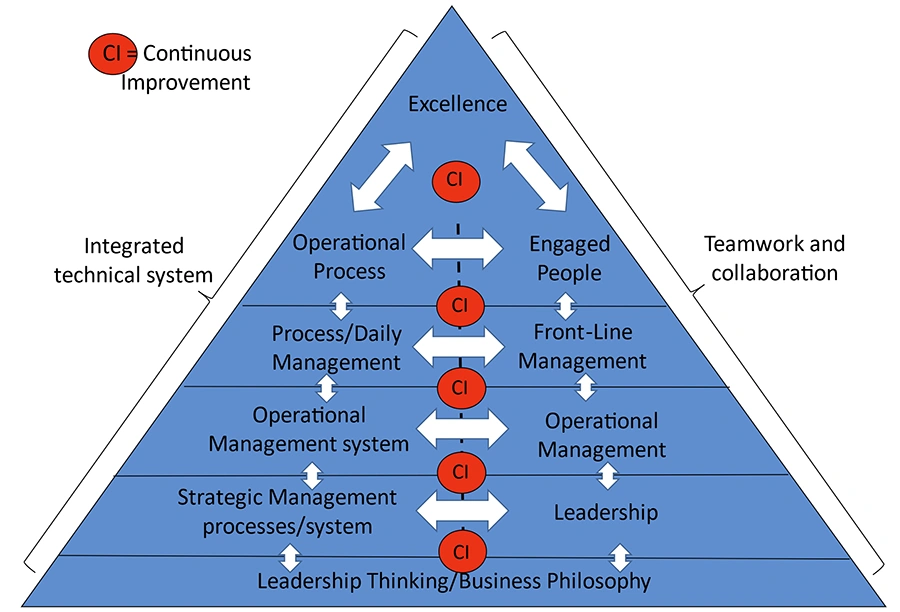
The core principles can be grouped into the twelve main areas outlined in Figure 1 below, which also shows how the principles relate and create a coherent whole creating a fully integrated dynamic socio-technical system.
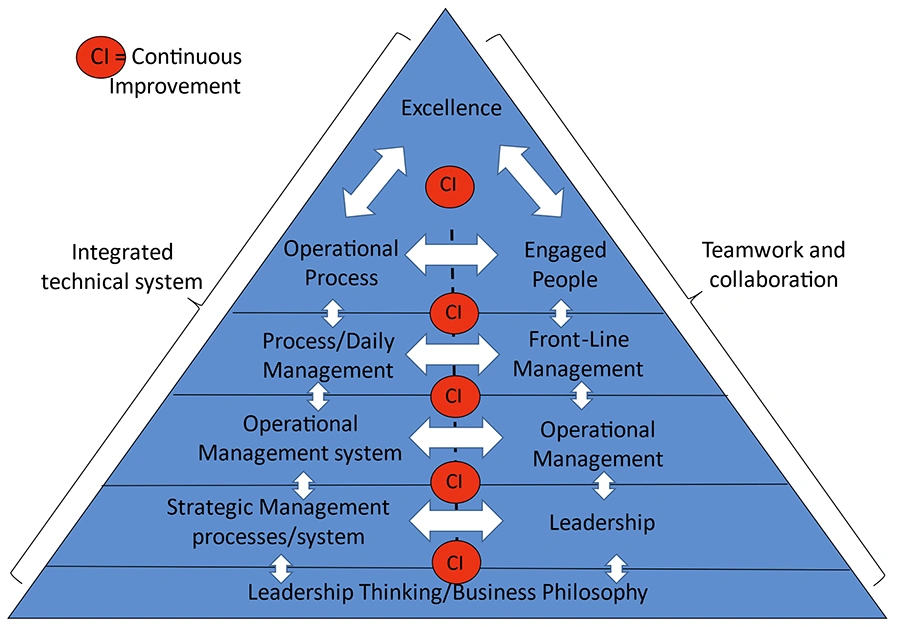
Figure 1 – Business Excellence Core Principles
Let’s look at these factors in turn, looking first at the three-way relationship at the top of the model between people, process and performance.
Organisations’ success is tied to their ability to perform. That is, to provide valued, cost-effective service to a target market in a way that is commercially sustainable.
To achieve excellent performance and results requires engaged people working with effective operational process. When led and managed well, this creates an upward spiral of engaged people, who both follow and improve the processes, working collaboratively tackling real issues: Solving real problems and grasping real opportunities. This creates increasingly strong results, which further builds people’s confidence, motivation and engagement and encourages them to improve further, finding ways to add greater value and remove waste.
The left-hand side shows the “technical system”, the chain of management processes from strategic to operational to daily/process management, the purpose of which is to equip front line colleagues with processes that are fit for purpose, lean, efficient, properly resourced, well-managed and continuously improved.
On the right-hand side is the “socio” part. The people factors and their interactions. These, necessarily start with effective leadership attitudes, skills behaviours, running through to operational managers’ effectiveness and that of the front-line managers who run the daily-management process and directly enable and facilitate front-line colleagues’ performance.
The model also, throughout, illustrates the interactivity and interdependence between the various factors. For example, should a leader have great skill, but not an effective strategy process, their effectiveness will be correspondingly diminished. And vice versa. An excellent strategy process in the hands of someone lacking the requisite understanding, skills and discipline to run it well will be similarly compromised. And so on up the chain of people, and the processes they rely, to the organisation’s front line.
The entire venture is founded on the thinking, principles and practices of excellence.
Finally, all aspects of the model are subject to continuous improvement both in their own right and as holistic dynamic, business system adaptive to its changing business environment/context.
Leadership thinking/Business philosophy
Business Excellence is based on a clear and coherent philosophy which represents a significant evolution from ‘traditional’ management thinking. Key tenets of this philosophy include:
- That sustainable and consistent success depends on meeting the needs of all key stakeholders; being first choice to buy from, work for, and invest in
- Operational excellence is the cornerstone of competitive advantage: The ability to deliver right first time, on time, every time, is the key to creating valued, loyal customers
- Process focus: The quality of the process determines the quality of the result: Well designed, and well run, maintained and improved processes are the bedrock of sustainable success
- Quality comes first: The cost of poor quality is significant, and often avoidable. When product or service quality is not right first time, it drives up the cost of inspection, correcting internal failures, and dealing with external failures. It also soaks up operational capacity and creates delays and impacts on delivery performance. Focusing on right-first-time quality minimises costs, and maximises productivity, customer satisfaction and, in turn, sustainable profitable sales
- Respect for people. Recognising people as experts in their roles, with the pride and motivation, who if properly led, will take responsibility for managing and improving performance
- Colleague engagement drives performance and improvement. Recognising that everyone can make a difference, and needs to make a difference, engagement means connecting with people to develop and deploy discretionary and excellence potential: Involving, enabling and empowering everyone in the business to be active partners in the management and improvement of performance
- The purpose of performance-measurement is to empower and inform: Clear, understandable, visible performance measures should be available to all colleagues, in real time, and used to understand and improve performance (rather than target criticism)
- Recognising Deming’s observation, that 94% of performance problems are due to the system, not people, when performance problems occur, asking “how did the process let this happen”, not “who’s to blame”
- Continuous-improvement optimises short-term performance and underpins long term success: Sustainable success means building the capability to adapt quickly and smoothly to daily operational challenges, and to wider, longer-term strategic change in markets, technology etc.
- Plan-Do-Check-Act (PDCA) thinking drives the management of daily performance and continuous improvement: PDCA is a constant loop of; defining both a goal and the method of achieving it; executing the plan; reflecting on the outcomes, and applying what was learned to improve the approach and outcomes on the next cycle
- Systems thinking: Managing the business as a complete interconnected system, with the focus on optimising the performance of the entire end-to-end value-stream, rather than individual elements in isolation
- Pursue perfection: Perfection is defined as the complete elimination of waste so that the customer can be served exactly what they need, and only what they need, when they need it, with no delay and at minimum cost. It is recognized as not wholly achievable, but that pursuing perfection will deliver the best of what is possible – excellence and continuous improvement.
- Constancy of purpose and long-term thinking: The need for short-term results is balanced with the steady, disciplined building of the capability for sustainable long-term success
Leadership excellence
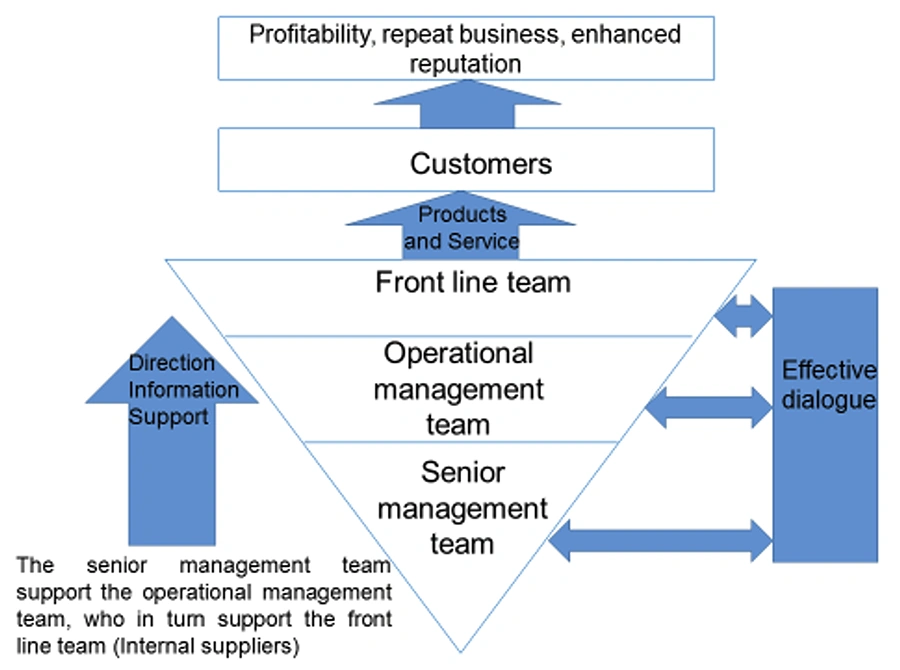
Figure 2 – Leadership guiding and supporting operational excellence
Leadership in organisations that are committed to Business Excellence begins with leaders understanding, actively role-modelling, promoting and supporting the above principles.
A large part of this, as illustrated in Figure 2, involves providing direction and support to the people who do the work that serves the customers. Specifically:
- Designing, overseeing and improving the Strategic Management System: The processes which define, communicate and implement the strategy for the business
- Overseeing and improving the Operational Management System: Together with Operational Managers, designing, running and improving the systems that oversee the effective running of the operational processes
- Being in touch with what is happening operationally:
- Through tiered meetings as part of the daily-management process
- Going to the front-line as appropriate, to see and directly understand, any significant challenges
- Actively supporting continuous – improvement efforts, by:
- Directly executing the high-level improvement projects identified in the strategy
- Monitoring the execution of strategic improvement plans at other levels
- Removing barriers escalated upward that are beyond the scope of operational teams to solve
Crucial to leadership excellence is setting the right tone and example for the culture: Leaders living the values of the organisation, leading by example in attitudes and behaviour, and working together effectively as a leadership team.
Underpinning this is the recognition that quality begins in the boardroom. As Deming emphasised:
Workers are not to blame for poor quality or productivity. The workers don’t determine the layout of the plant, the room temperature, the amount invested in research, development and training. They don’t buy the equipment, tools and raw materials or determine the design of the product. In short, they don’t determine 90 per cent of the things responsible for the quality of the product. [Furthermore] workers cannot change the system, only management can change the system. It is management’s responsibility to change the system so that quality and productivity can improve and workers can experience pride of workmanship. Once that happens, worker input becomes a continual part of the improvement process.
Engaged People
Recognising that everyone can make a difference, and everyone needs to make a difference, engagement means connecting with people to develop and deploy their discretionary and excellence potential: Involving, enabling and empowering everyone in the business to be active partners in managing and improving performance.
Enabling and empowering means supporting people to:
- Perform, by providing the basic tools, training, raw materials, information and ongoing management support
- Solve problems and improve processes by providing information, time, and training in problem-solving techniques. And an environment free of fear where they can openly discuss and address improvement opportunities
The ultimate aim is to create a “Thinking People System”: A business system which unlocks people’s wider capabilities, and which as a result, becomes better at preventing and solving problems, and continuously improves. A system which is flexible, agile, responsive, resilient, and stays aligned with the changing needs of its customers.
The dynamic which fosters the simultaneous development of people, process and performance is illustrated in Figure 3: A virtuous cycle of enabling and empowering people to understand and improve processes, which develops people’s process-understanding and problem solving skills and also improves performance. This in turn provides motivation and encouragement to remain engaged in the quest to understand and improve the process further.
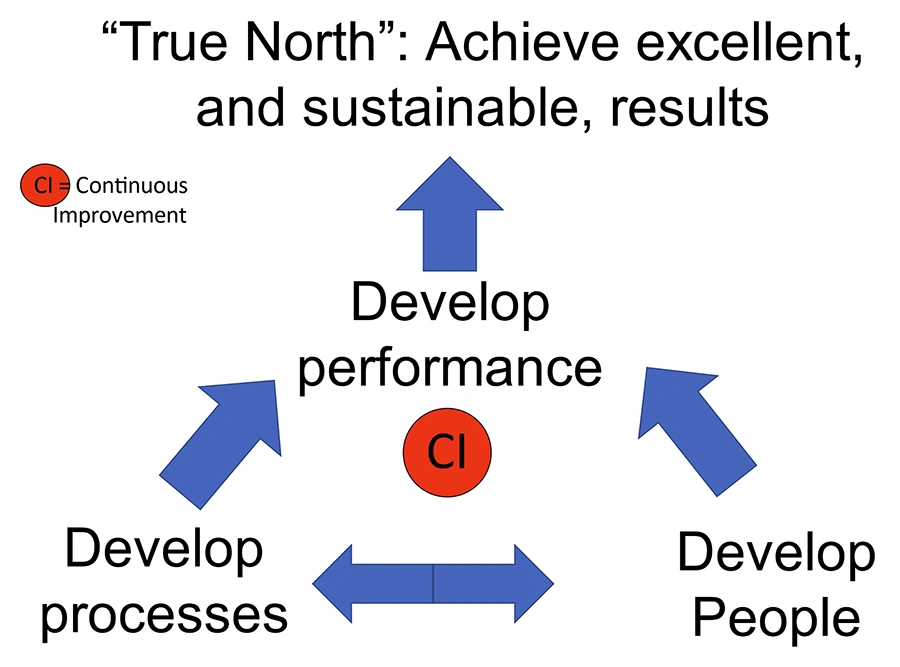
Figure 3 – Simultaneous development of people, process and performance
The foundations for this are:
- Respect for people. Recognising that people are the experts in their own job, are motivated, to perform to a high standard and continuously improve, and will do so if properly led, engaged, empowered, and developed
- As well as empowering and enabling people, making it clear to them that their everyday responsibilities include both doing the job well, and improving how the job is done
- Agreeing challenging goals which stretch people and lead them toward a deeper understanding of, and sense of responsibility for, performance, processes, and problem-solving
Inspiring people is removing obstacles more than lighting fires.
(Peter Block)
Key factors in enabling, supporting and promoting engagement are:
- Positive leadership: Senior colleagues, starting at the top, leading by example, role-modelling the values, attitudes and behaviours which actively promote and support the principles and practices of Business Excellence
- Hygiene factors met: Basic expectations which if not met will create a black hole of dissatisfaction and distrust that cannot be compensated for by any ‘motivator’
- Clear expectations: Of goals, standards and methods
- Tools, equipment and resources: Of the right quality, available at the right time
- Capable processes: Well designed, reliable processes, working within capacity
- Skills and knowledge: Adequate quality and breadth of training
- Information on performance: Timely, frequent, actionable, facts and data
- Appropriate autonomy and responsibility: The right degree of empowerment, authority, and responsibility to performance and improve
- Accountability: Answerable for decisions, actions, performance and results. Regular opportunities to discuss performance, problems and ideas: Scheduled, regular, constructive forums, free from fear
- Effective coaching: As part of everyday work to develop rounded, confident, responsible people with strong job skills, problem-solving skills and interpersonal and team-working skills
- Structured-problem-solving skills and tools: The availability of a shared, language and toolkit for structured problem-solving, with all colleagues trained to at least a basic level to enable them to contribute meaningfully to improvement activities
- Involvement in problem-solving activities: To contribute insights and ideas to improve process and performance, and to simultaneously further develop their understanding of the process, and their problem-solving skills
Process excellence
Process excellence is the capability to deliver what the customer (internal or external) requires, right first time, on time, every time, at the right cost. The ultimate aim is to build a process which can produce predictable and repeatable results. Process Excellence is the bedrock on which the success of the business is built.
Processes include all aspects of business performance from research and development, marketing, sales, supply chain, and operations, to logistics and after-sales service. (Anything with a clear, desired output, inputs, and a series of steps that are followed in roughly the same sequence each time, is a process)
And since business success is not the result of mystical events but of process effectiveness, it is necessary to explicitly focus on process design, management, and improvement as a matter of strategic importance.
Process Excellence is an expansive topic, and in some businesses highly technical and specialised. These eight factors are relevant to most. An optimised process:
- Is aligned with the Voice of the Customer (VOC): It is understood who the customers are (internal or external), what they want, and (in the case of the paying customer) what they are prepared to pay for
- Flows: Work and information flow efficiently through the process without defects, delay, or unnecessary effort
- Is balanced: Each stage of the process should run at the same speed (“takt time”) as others, rather than some stages running faster or slower, causing work to build up in some places while others are underutilised
- Is even, and operates within capacity: Process capacity should be closely-matched to demand and the process is neither significantly underutilized, nor overburdened
- Is standardised: The best currently known approach to tasks should be captured, followed, and used as the baseline for further improvement
- Is properly resourced, organised and maintained: The process should be resourced with sufficient:
- People with the right skills, experience, attitudes and motivation
- Equipment, tools, space
- Raw materials, consumables,
- Time
The resources also need to be of the right quality, and available in the right place, at the right time, in working order, allowing people to work efficiently, with no avoidable down time across the working day
- Is error-proofed: The key stages of the process (particularly those that are easy to get wrong, and with serious consequences) are error-proofed
- Is pulled, not push: Activity is triggered only by a confirmed requirement, rather than in anticipation of demand that may not materialise
Process/Daily management
Daily management (or process management) is the ongoing monitoring, course-correction, and improvement of operational processes. Components of effective daily management include:
- Measurement: Process performance is measured, including quality, delivery-performance and cost. Visual measures allow front-line colleagues to easily see if something is off track, enabling them to take immediate corrective action
- Constant process monitoring: Of key measures, work-flow and other vital signs, to allow responsive:
- Course-corrections, adjustments and fine tuning to keep performance on track
- Running repairs: Identifying and fixing problems before they escalate
- Identification of deeper-seated process issues
- Daily Accountability Meetings: Daily management revolves around a series of tiered meetings, known as “Three Tier” meetings (though there may be more or less than three depending on the size and complexity of the business).
- Tier One meetings are the main forum for front line managers and team members to review ongoing activities and results, to identify and address immediate problems, and flag up wider problems. Immediate corrective action is taken where possible, and improvement opportunities that cannot be dealt with immediately are recorded for future actioning
- The outcomes of the Tier One meetings are then fed into Tier Two meetings at which the operational managers assess the performance of the entire value-stream end to end, handle any issues escalated to them, make necessary adjustments, and record any improvement opportunities that cannot be actioned immediately
- Similarly, the outcomes from Tier Two (operational status, issues requiring discussion, decision or action) are fed up to the senior level “Tier Three” meeting
- Individual check-ins: To ensure that every colleague, every day, is engaged, accountable and has the opportunity to discuss any concerns or issues
- Gemba walks: Regular focused inspection of the workplace, and how work is being done, including layout, orderliness and cleanliness, condition of buildings and equipment, safety, and morale
- Continuously improving operational processes: Improvement opportunities identified through the above forums, and those percolated down from the in the strategic plan, are systematically captured, prioritised and addressed through using a structured problem solving methodology that allows the root causes of problems to be identified and removed, to continually increase process capability, stability and resilience
- Managing demand: Demand is monitored and managed (its nature, timing and frequency) so it matches process capability and is not continually changing in a way that disrupts process flow and creating inefficiency
- Resourcing, priming and maintaining the operational processes: Providing the right people, tools, materials etc, all in the right place at the right time, to facilitate efficient working for the full day
Management effectiveness
The role of managers at all levels is to engage people in a consistent, constructive, adult dialogue to enable them to become high-performing, low-maintenance contributors who deliver sustained world-class performance and continuously improving results.
Managers are expected to thoroughly understand the work of the team that they are leading. They are also expected to have strong problem-solving and coaching skills so that they can engage people positively to develop their understanding of performance and processes, and to help them become empowered and confident problem-solvers.
Success in management requires a broad range of attitudes, skills and other qualities, summarised in the diagram below.
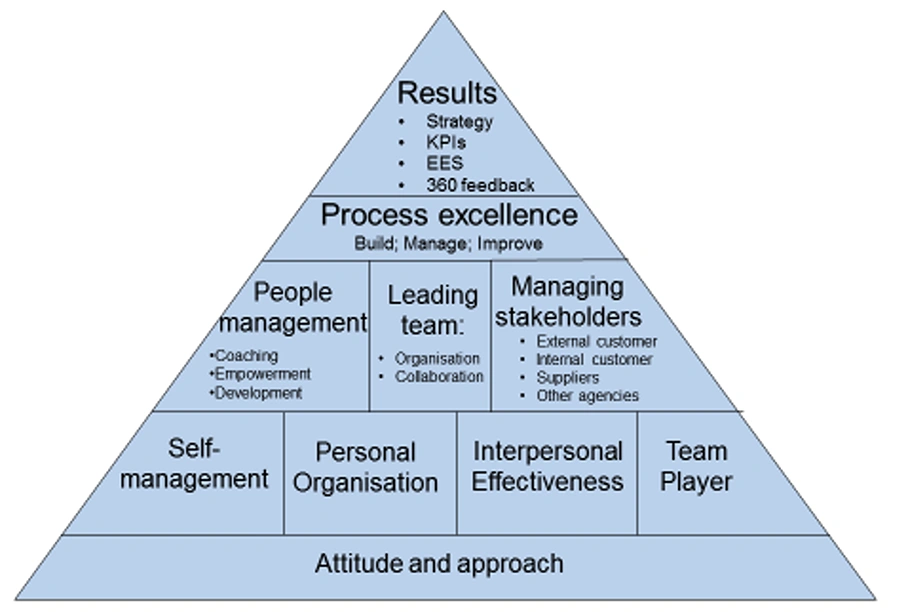
We’ll explore each one briefly in turn.
- Attitude and approach: Being positive, a problem solver and taking responsibility for personal and team performance, and making things happen
- Self-management: Emotionally balanced, calm, strong resilient, persistent
- Personal organisation: Managing priorities, time and energy effectively
- Interpersonal effectiveness: Building strong working relationships with people with different personal styles. Able to handle challenging behaviours and difficult situations
- Team player: Collaborating effectively with others within own departmental team, cross-functionally and at different levels
- People management: Able to organise, empower, coach and develop people, and to deal with underperformance and disciplinary issues
- Leading the team: Being able to get the mix of characters in the team to work effectively, solve problems, and improve processes as a unit
- Managing stakeholders: Ensuring that key stakeholders’ expectations and perceptions remain informed and realistic so that processes do not become under-resourced or overburdened
- Process excellence: Ensuring that the processes are effectively designed, managed and improved, enabling people to consistently achieve excellent performance
- Results: Measures of effective management may include:
- Consistently strong, and continuously improving, performance against Key Performance Indicators
- Sustained progress toward strategic improvement goals
- Consistently high employee engagement scores
- Strong scores on leaders’ 360 degree reviews
Beyond these expectations which all managers share, there are specific responsibilities for front-line managers and operational managers
Front-line managers
Front-line managers’ responsibilities include:
- Daily management:
- Daily accountability meetings (The Tier One meetings)
- Constantly monitoring process performance, and communicate with front-line colleagues to identify and address emerging problems early
- Coaching front-line colleagues effectively to develop the required skills, attitudes, and behaviours
- Continuous improvement of the operational processes, and of the Daily Management Process, in response to improvement opportunities identified:
- Locally
- In the strategic plan
Operational managers
Operational managers’ responsibilities include to:
- Oversee and integrate the daily-management of the core processes end-to-end across the business
- Ensure that front-line managers have what they need to provide front-line colleagues with the right, tools, equipment, information and resources to succeed
- Coach front-line managers effectively to develop the required skills attitudes, and behaviours
- Oversee, integrate and monitor the continuous-improvement activities happening at the front line
- Actively engage in, and support, continuous-improvement efforts, helping remove barriers that front-line managers can’t
- Continuously monitor and improve the performance of the daily management process and the operational management process
- Implement the continuous-improvement projects associated with the breakthrough goals in the strategic plan
Operational Management System
Effective management, while requiring strong personal qualities, is not based on charisma or personality. Just as front-line colleagues need effective operational processes to deliver excellent performance, so managers requires effective management systems; Processes that allow them to do their jobs effectively, systematically and consistently.
At Operational level, this requires an Operational Management System. A coherent set of processes that oversees, and integrates all the core operational processes end-to-end along the whole value-stream and ensures that they operate, and continuously improve, as a coherent system.
The main functions of the Operational Management System are:
- Monitoring and managing demand: Monitoring of immediate demand, (nature, frequency, volume) and longer-term projections to inform the planning, scheduling and resourcing of the operational processes. The overall stability, predictability and controllability of demand is also assessed, and ways found to enhance the management of it to achieve greater process stability, predictability and control
- Planning and scheduling activity: To match process capacity and customer demand and ensure that process are neither significantly under-utilised, nor pushed into overburden. All targets, activities and timings are communicated clearly, systematically and timeously
- Aligning operations with strategic direction and goals. Ensuring that:
- The business is delivering on the operational business-as-usual goals on delivery performance, cost and customer satisfaction
- The annual breakthrough goals set within the strategy process are cascaded to each operational area as appropriate, and executed
- Resourcing the operational processes: Ensuring that the processes are properly resourced with the right quality and quantity of raw materials, tools, equipment, consumables, space, working conditions, and the right numbers of people with the right skills, experience, attitudes and motivation. And that it is all in the right place and at the right time to maintain flow in the operational processes
- Constantly monitoring the daily management processes
Through overseeing the operation of the Daily Management Process and gathering information fed in from the Tier One meetings, all key measures and other vital signs are constantly monitored to ensure the smooth flow of work through the operational processes and responsive:- Course-corrections, adjustments and fine tuning
- Running repairs: Identifying and fixing problems before they escalate
- Identification and capture of deeper-seated process improvement opportunities
- Managing and developing the front-line management team: Front-line managers are held accountable for fulfilling their responsibilities and are coached, developed and supported to perform well and continuously improve
- Continuous improvement of three different sets of processes, to continually increase their capability, stability, coherence, flexibility and resilience, and underpin long-term sustainable success:
- Operational processes – end-to-end across the whole value stream including all supporting processes
- Daily/Process Management System
- Operational Management System
Strategic Management System
The Strategic-Management System is a coherent set of processes that ensure a consistent and structured focus on building the business’s longer-term capability.
The Strategy Process:
- Monitors the external environment for a range of factors including changing markets, customer needs, technology, and political and social conditions
- Monitors internal factors including people (morale, skills, retention, motivation etc) processes, technology, and culture.
- Analyses the information to establish the business’s strengths, weaknesses, opportunities and threats
- From this, develops a robust long-term plan to mitigate threats and capitalise on opportunities. (What “long-term” means varies between industries and businesses)
- Breaks this plan down into departmental and team plans, and cascades it through the business in a way that confirms the feasibility of the plan and secures understanding of it, and commitment to it
- Supports and monitors the successful execution of the strategic plan (while ensuring that it does not cause problematic disruptions to business-as-usual operations)
Continuous improvement
Improvement is eternal and infinite.
(Taiichi Ohno)
For every business there is the ever present threat of waste and inefficiency clogging up the value-stream, compromising quality, cost, and delivery performance. And even when products, services and processes are in good shape, in an ever-changing world with constantly increasing demands, there are always opportunities, and a need to continuously improve.
To manage this effectively, the business needs a disciplined approach to continuous improvement in all parts of the business, and every aspect of performance. With continuous meaning continuous; a core activity, part of normal day-to-day operations – not triggered only by crisis.
Creating a culture of continuous improvement requires:
- A toolkit to give help people the means to map the value stream, identify improvement opportunities, and take a structured approach to problem solving; establishing root-causes and permanently resolving problems
- Empowering front-line people to drive continuous improvement: To build ownership for performance and results, and simultaneously develop the process, people and performance, to build an organization that learns and adapts quickly. This requires:
- Training colleagues in continuous-improvement tools and techniques
- Support and encouragement for teams and individuals to take time to improve things
- Making expertise available to help guide and mentor teams and bring in more specialized problem-solving tools and techniques as required
- Management systems that bring problems to the surface. Focusing on improving how quickly and how well work flows through all processes (operational, management, or strategic) allows barriers to be more easily identified and addressed.
If you don’t confront your problems you can’t improve.
(Jeffrey Liker)
Effective Teamwork and collaboration
The interdependency among people and processes requires a team approach to managing and improving performance. The quality of teamwork depends on how well people across the business, and at different levels understand, respect and trust each other, and communicate, share information, collaborate and work as a team to solve problems.
This takes time and effort to build and maintain, can be fragile when things go wrong, but is essential to create the environment of collaboration and open and honest communication on which excellence depends.
Performance: Excellent and sustainable results for all stakeholders
And finally, back to the ultimate aim: The creation of enduring value for customers, employees and business owners, so that everyone is motivated to continue their commitment to the business. This would include the business consistently achieving or surpassing targets for operational performance, customer satisfaction, profitability, and for colleague engagement, environmental performance and corporate social responsibility.
Summary
For the business to be excellent, the processes which produce the goods or service must be effective and efficient. For that to happen the business must be able to systematically and continuously improve those processes.
This, in turn, depends on open, honest and constructive dialogue among people to recognise problems and work together to create solutions at, and between, all levels of the business. This requires the right tools and training in problem-solving and an Operational Management System and Strategic Management System that provide a relentless focus and discipline around high performance and continuous improvement.
The tone for all of this is set by how people are led, and in particular, the personal example in attitude, behaviour and competence that leaders set.
Questions:
- What are the strengths and improvement opportunities for your business?
- Is this journey for you?
