Introduction
For many businesses, recent years have been challenging. Markets are saturated, costs are high, margins are slim, talent is in short supply, working environments often feel more stressful than rewarding, and the speed of technological innovation simultaneously reveals new ways of working and new vulnerabilities.
For ambitious leaders and businesses, these challenges invite a strategic and systematic response – one that will confer long-term advantage. So, in this series we’ll outline some core, time-tested management principles that have often been overlooked but are central to business success in any era, or in any phase of the business cycle. And we’ll explore how applying them now can help your business more fully meet the challenges and grasp the opportunities of the coming year and beyond.
Part one: Leadership and culture
What does it take to create the conditions for enduring success?
The highest-leverage influence on business performance and results is culture and the leadership thinking and behaviour that shapes it.
The culture of a business, generally falls into one of four categories:
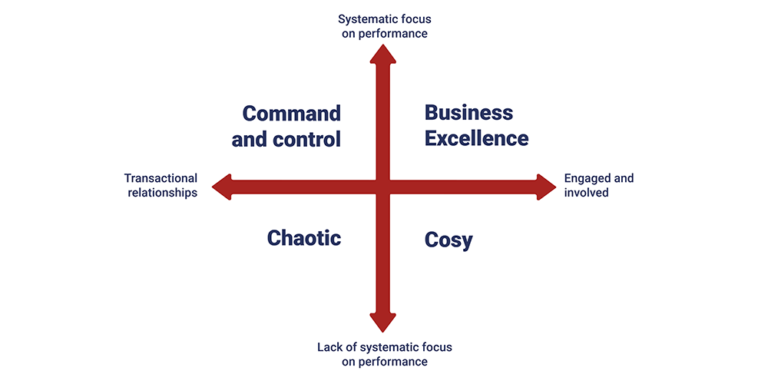
The highest-leverage influence on business performance and results is culture and the leadership thinking and behaviour that shapes it
Excellence is built on a comprehensive and coherent approach to managing business performance across all time frames, from short-interval control to long-term strategy. The capability to manage business performance, in and of itself, is understood as a fundamental asset: the key to resilience, adaptivity and financial performance.
So, what are the guiding principles of an excellence culture?
- Quality comes first – because quality problems ripple through the business and create issues with delivery performance, cost, customer satisfaction and productivity
- Get the process right. Even the best people can’t outperform a poor process, so processes must be tightly managed and relentlessly improved by identifying and removing anything that wastes time or money, or causes quality problems. (Process, of course, includes the strategic and operational-management processes as well as the operational processes)
- People are engaged and accountable. All colleagues are developed and equipped to be experts in their role. They are empowered to solve problems and improve their processes, and given the data, tools and training to allow them to do this
(For a more in-depth look at the principles of Business Excellence, here’s a 13-point analysis.)
Why excellence – and what’s next?
Creating the conditions for enduring business success requires a comprehensive, coherent and integrated approach to business management. When designed well and pursued with rigour and consistency, this enhances an organisation’s ability to get the best from its people, solve problems, improve, innovate, be profitable and grow.
Behind this is an ecology of capabilities that brings focus to the people-management and process-related strengths that businesses require to deliver consistently excellent results. Through this series, we’ll explore each of these capabilities to offer you some tools and insight that we hope will help you improve performance and lay the foundations for enduring success.
Let’s get to work
Over 27 years of practice, we have developed a comprehensive, time-tested and field-proven business-improvement model and toolkit. We partner with ambitious businesses to identify strategic breakthrough opportunities in capability, performance and results, and we provide the tools, support, training and coaching to complement their existing expertise and help them achieve these.
If you’re aiming to build or optimise a business system using sound principles, values and standards to deliver consistently excellent and continuously improving results, we can help you develop and implement a strategy to accelerate progress and amplify the impact of your journey.
To get in touch, contact us here to book a free consultation.
Discover more of our tools and methodology in our book Toward Excellence.
