Two fish swim past each other. One says, ‘The water’s lovely.’ The other replies, ‘What’s water?’
Like water for fish, the management system, so fundamental, pervasive and all-encompassing, can be strangely inconspicuous in organisations. Even when its shortcomings lead to significant, widespread problems, it can go unnoticed, unquestioned and unchallenged.
What is the management system?
Think of the management system as the central nervous system of the business. It is the set of processes that measure and manage performance across the whole business, and at all levels: it plans, monitors and regulates performance, coordinates the various operational processes to promote coherent functioning day to day, and enables ongoing strategic adaptation.
The management system determines what gets measured, how the information is used and, crucially, what happens when problems are identified. It touches every person and every activity. It shapes the culture, influences people’s attitudes and behaviours, and is a major determinant of business performance.
It comprises two related systems: the strategic management system and the operational management system. These inform, guide and oversee the management of the core processes, as illustrated below:
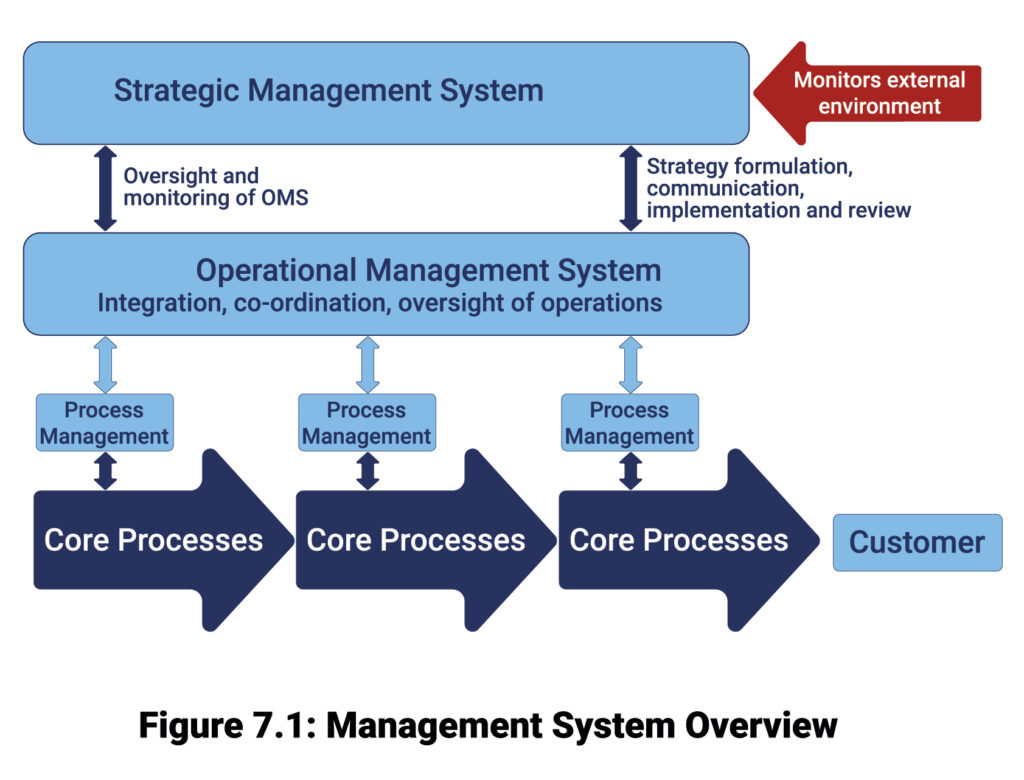
The strategic management system sets the purpose, direction, goals and strategy for the business. It:
- Defines the purpose, aims and values of the organisation
- Monitors the external environment to assess the status of markets, technology, legislation etc.
- Identifies the core capabilities the organisation requires to succeed in its chosen markets
- Assesses the current capability of the organisation
- Analyses and integrates internal and external perspectives and plans how best to achieve:
- Operational control, to ensure that the operational processes perform optimally and improve continuously
- Strategic breakthroughs in key areas, to achieve sustainably higher levels of performance
The design, management and ongoing improvement of the management system is a leader’s most fundamental, and highest-priority, task
The operational management system is the set of processes that macro-manages ongoing business operations. Its functions include:
- Monitoring and managing demand
- Planning and scheduling activity
- Resourcing
- Integrating and coordinating the operational processes end-to-end along the value stream
- Aligning operational activity with strategic direction
- Overseeing and coordinating process management: the day-to-day measurement, management and improvement of front-line processes
- Managing and developing people
The highest-leverage leadership work
Professor Emeritus of Business Performance Umit Bititci wrote that ‘transforming measurement and management … is not just a leadership issue, it is, given the impact on sustainable success, arguably the leadership issue.’
An effective management system creates an aligned, informed and motivated culture that is equipped to achieve sustainable success. An ineffective management system risks widespread and entrenched dysfunctionality that will consistently constrain performance and progress.
This means that the design, management and ongoing improvement of the management system is a leader’s most fundamental, and highest-priority, task, and the highest-leverage improvement that an organisation can make. If it isn’t on your to-do list yet, what’s stopping you?
Let’s get to work
Explore more about Business Excellence and leading transformations here
Our book, ‘Toward Excellence’, will be published in September 2025
To get in touch, reply directly to this email or go via our contact form
